A director’s treatment that makes the film imaginable
A director’s treatment explains how an idea will become a film: its central point of view, visual world, performance, camera, edit, sound, and important production constraints. Use references to explain specific choices rather than collect a general mood. This fictional campaign example demonstrates a compact treatment structure you can adapt with your own material.
UPDATED 2026-09-06
A treatment should make the film imaginable
A director's treatment explains how an idea will become a film. It combines a point of view with enough visual and practical detail for someone else to understand the proposed execution. A collection of beautiful stills can support that explanation, but it cannot supply the explanation on its own.
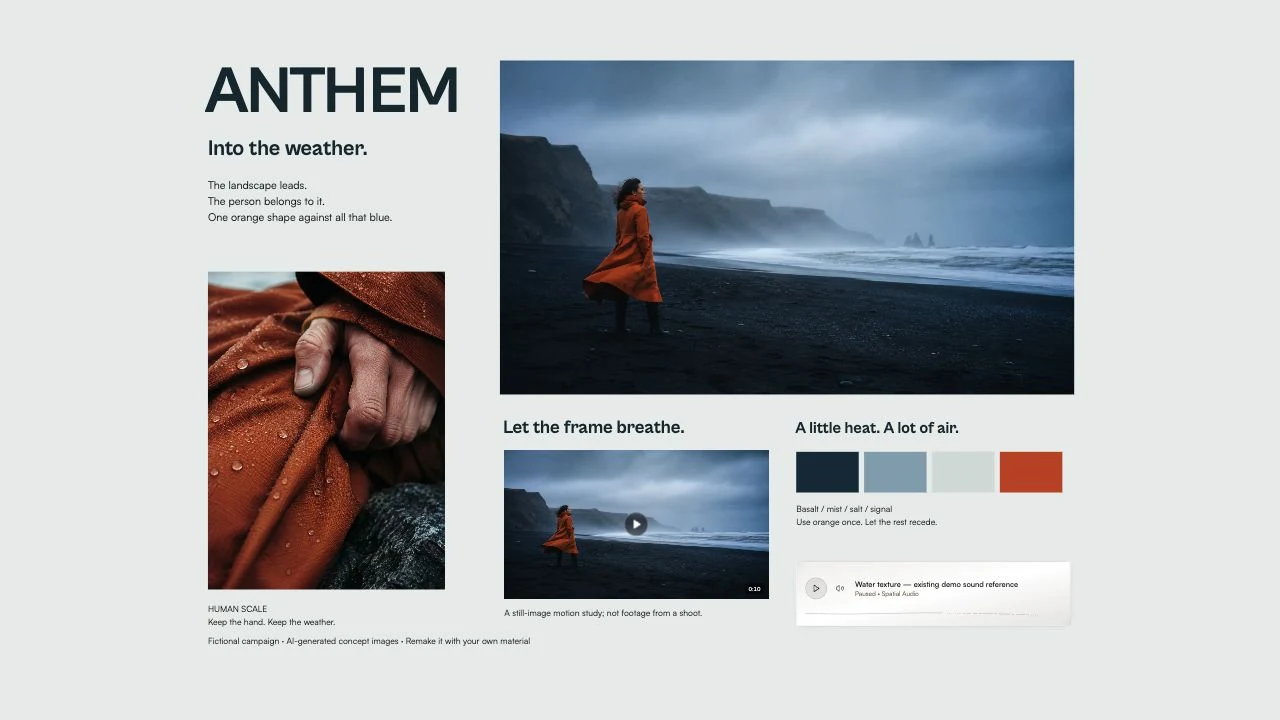
This guide uses Anthem, a fictional coastal campaign, as a compact example. Its photographs are AI-generated concept studies, and its moving image is a pan across a still. It is not a commissioned treatment, finished commercial, or record of a real shoot. The board exists to demonstrate an approach you can adapt with your own material.
Begin with the central idea
Anthem's direction is: the landscape leads, and the person belongs to it. The concept uses a single orange coat in a large blue-grey environment. That relationship should survive every later choice, from the opening wide image to the close study of a hand gripping wet fabric.
Your opening statement should explain what is distinctive about your interpretation. “Cinematic and authentic” is too open to guide a crew. A more useful statement names a relationship, action, or tension: a character stays still while a place moves around them; a crowded room is told through small private gestures; a product is understood through the hands that use it.
Write that idea before collecting a large volume of references. It gives you a way to reject material that looks impressive but belongs to another film.
Show how the viewer enters the world
The first image in a treatment establishes expectations. Anthem begins with distance. The environment occupies most of the frame, and the human accent gives the eye a place to land. That suggests an opening in which we understand the weather before we inspect the garment.
Describe what the viewer encounters first and what is withheld. Is the opening observational or immediate? Do we hear something before we see its source? Do we begin with a face, a detail, a place, or an action? A treatment becomes more useful when a reader can imagine the experience over time rather than merely recognize a visual style.
Use images that support those decisions. Keep their role explicit: composition, lighting, movement, performance, material, or atmosphere. A reference can inform one of these without prescribing all of them.
Move from world to human detail
The close-up in Anthem is a different scale of the same idea. Rain, fabric, and a hand carry the weather into the human frame. This prevents the treatment from becoming two unrelated collections: beautiful landscapes on one side and product details on the other.
Think about transitions between scales. A wide image can establish isolation; a gesture can make it personal. A material detail can answer something suggested by the establishing image. Arrange the references so that the reader experiences that progression. On a canvas, proximity and size can help explain the transition before you say a word.
Do not confuse a progression with a complete storyboard. If the action depends on exact continuity, add a more detailed sequence. A compact treatment can establish a direction while openly leaving the shot-by-shot execution for the next stage.
Give motion and sound their own jobs
| Element | Anthem's proposal | What still needs a real production decision |
|---|---|---|
| Camera | Begin with a restrained move rather than a rapid reveal | Actual camera position, lens, support, and safe access |
| Performance | Small gestures inside a larger environment | Casting, direction, wardrobe behavior, and rehearsal |
| Edit | Leave time to read the environment | Timing against the final duration and required deliverables |
| Sound | Use a water texture to discuss atmosphere | Recording, music permissions, sound design, and mix |
| Color | Keep a warm focal point against a cool ground | Wardrobe, location, exposure, and finishing tests |
The animatic on the board helps discuss pace, but it does not demonstrate how a coat or person will move in live action. The listening reference suggests texture, but it is not the sound of the pictured location. Label these limits directly. A useful treatment helps a team distinguish a tested choice from an attractive hypothesis.
Explain the production implications
A reference image can hide the work needed to make it. Remote terrain may change access and crew needs. Weather may affect scheduling. A tight crop may require a different setup from the wide frame beside it. Show the implications you already know, and label the decisions that still need a scout, test, or production conversation.
For a real version of Anthem, the next stage would include selecting an actual location, checking access, planning around conditions, and testing whether the intended wardrobe reads at the proposed distance. This demonstration does not establish any of those facts.
Keep the treatment focused on direction. Detailed logistics can live in production documents linked from the board. The reader should understand the ambition and its important constraints without mistaking the treatment for a call sheet, final budget, or location approval.
Give the treatment a presentation order
A workable short sequence is: central idea, visual world, human detail, motion and sound, next decision. Each part should answer a new question. Repeating the central idea in different words adds length without increasing understanding.
On Anthem, the guided walk moves through these scales and finishes on the full board. You can inspect individual references and then see how they form one argument. When adapting the structure, remove a section if it does not help your project. Add a section when the execution depends on something the current board cannot explain, such as choreography or a complex change of location.
For practical meeting guidance, read how to present a moodboard to a client. Presentation should reveal the decisions in a useful order, not simply advance through every item collected.
End with the decision that unlocks the next stage
A treatment should leave the reader knowing what you recommend and what needs to happen next. For this example, the useful question is whether the balance between landscape and human detail is the right direction to develop. Once that is settled, the team can invest in a real scout, tests, and a more precise sequence.
Avoid presenting a concept board as evidence of results it has not produced. Keep inspiration sources, generated studies, tests, and finished work distinguishable. If you show commissioned work, use material you can legitimately share and describe your actual role.
Open the Anthem treatment, or begin with the storyboard template. Replace the demonstration content with your own idea, references, and known constraints. The goal is not to fill every space. It is to make the film clear enough that the next conversation can be specific.
Questions
- Can I use this example as a starting point?
- Yes. Open the Anthem board and choose Make it mine to copy it into your account. Replace the concept references with your own material and adapt the structure to your project.
- Is Anthem a real client project?
- No. It is a fictional campaign demonstration with AI-generated concept imagery. The animatic is a camera move across a still; it is not live-action footage.